
Striders History
History of the Howard County Striders is based on our archives, newsletters and personal testimony from club members. Striders would like to acknowledge Mr. Greg Lepore for archiving decades of Footprints newsletter and compiling information used to prepare our history. Please contact president@striders.net if you have comments or questions.
Howard County Striders: A Legacy in Motion
The Howard County Striders have been part of Maryland’s running community for fifty years. They started in the 1970s with a small group of runners who simply enjoyed meeting up and racing. Over time, the group grew into a large community that welcomes runners of all ages and abilities. Their Saturday Bagel runs became a weekly ritual, and their races brought out crowds from across the region. More than anything, the Striders have built a place where people make friends, stay active, and enjoy running together.
Looking for our Hall of Fame or Footprints Newsletter Archives?
The 1970s: First Steps
In the early 1970s, Howard County’s running culture was still in its infancy. On January 7, 1974, Olympian and four time top three finisher at the Boston Marathon Don Heinicke joined Jack Ward and Ken Denson to begin organizing a running club that would evolve into the Howard County Striders. That same year, two teams competed in the Lake Montebello 18.87-mile relay, and forty-four runners raced in the inaugural Turf Valley to Hidden Valley ‘Run for the Barbecue.’ Even in its first year, the group made a statement with their team placing fourth in the Maryland Marathon, led by 60-year-old John Wall’s remarkable 2:59 finish.
In June of 1977, Columbia Bank and Trust and The Columbia Flier sponsored the first Columbia Olympics to celebrate the “New City’s” 10th birthday. The Striders put on three races, a three miler and a seven miler on Saturday, June 25th, and the first Metric Marathon on Sunday, June 26th. Although the Striders numbered only 30-40 members at that time, several hundred runners participated in the three races, including 148 who finished the Metric. The success and popularity of the Birthday Olympics encouraged the Striders to become much more active, and the club started a series of weekly races each Sunday afternoon at numerous different sites around the County. The weekly events were organized into four quarterly series throughout the year. Thanks to excellent coverage by the The Columbia Flier and the Howard County Times, plus weekly updated point standings that encouraged participation, the number of runners grew dramatically, and with that, so did the Striders’ membership.
Don Heinicke was finding the administrative aspects of the club to be daunting, and urged some of the younger runners to get involved. Dave Tripp and Warren Ohlrich took up Don’s challenge. Dave became President, and Warren, who resigned from the N.S.A. to open the Feet First running store in Wilde Lake Village Center, became Treasurer and Director of Special Races. Dave took on the administrative aspects of getting the Striders incorporated as a 501©3 non-profit corporation, joining the Road Runners Clubs of America and securing insurance, while Warren made Feet First the Striders’ semi-official headquarters, took over the race directorship role for the special races and started a weekly Saturday morning run from the Wilde Lake Village Center.
With participation and membership skyrocketing, the Striders formalized the weekly run series, inaugurated the Clyde’s American 10K, moved the Metric Marathon to a November date, and built on the Columbia Olympics with the Columbia Birthday Classic, a distance event that increased by one mile per year as Columbia aged. (Because the event was held in June, the tradition stopped at 13.1 miles in 1980 due to the heat and humidity.)
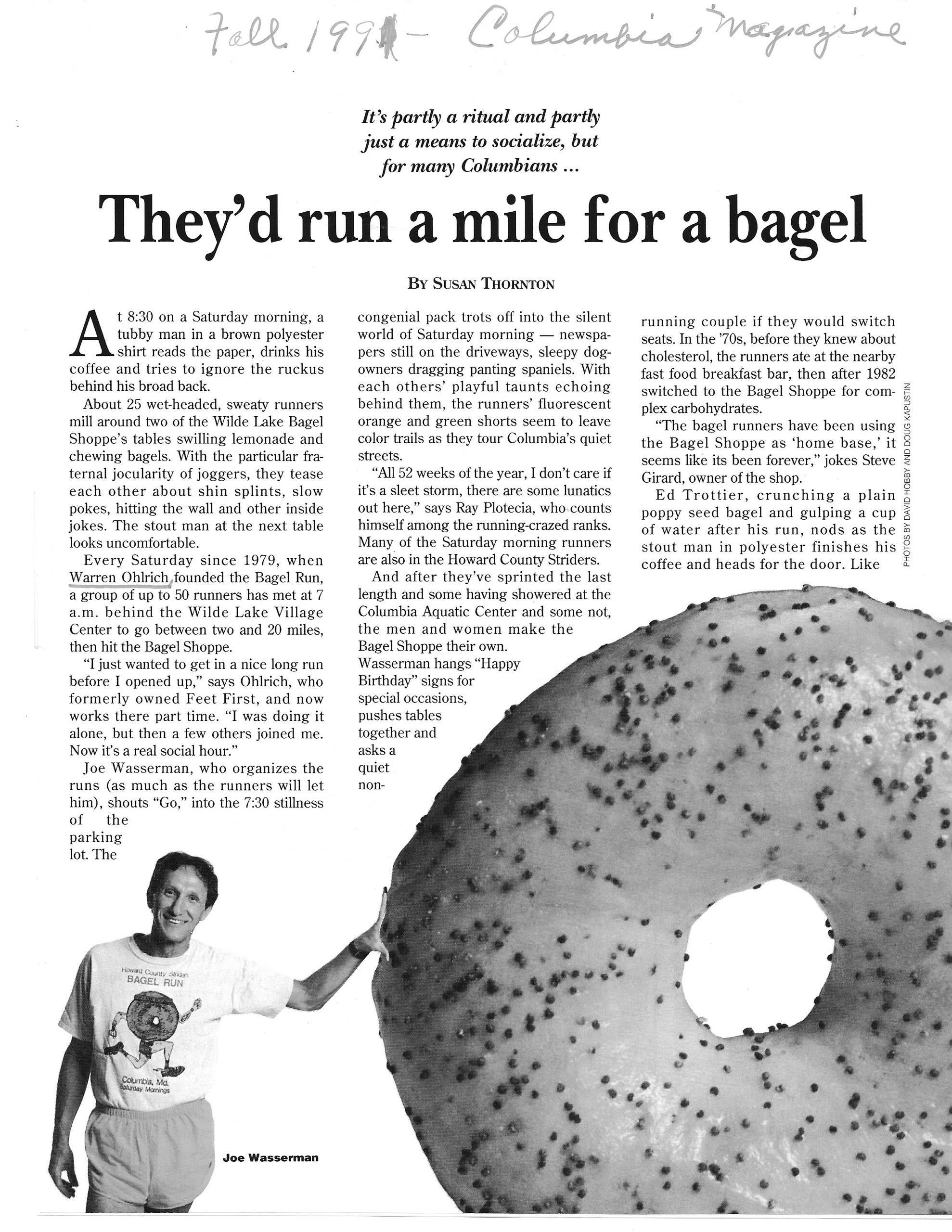
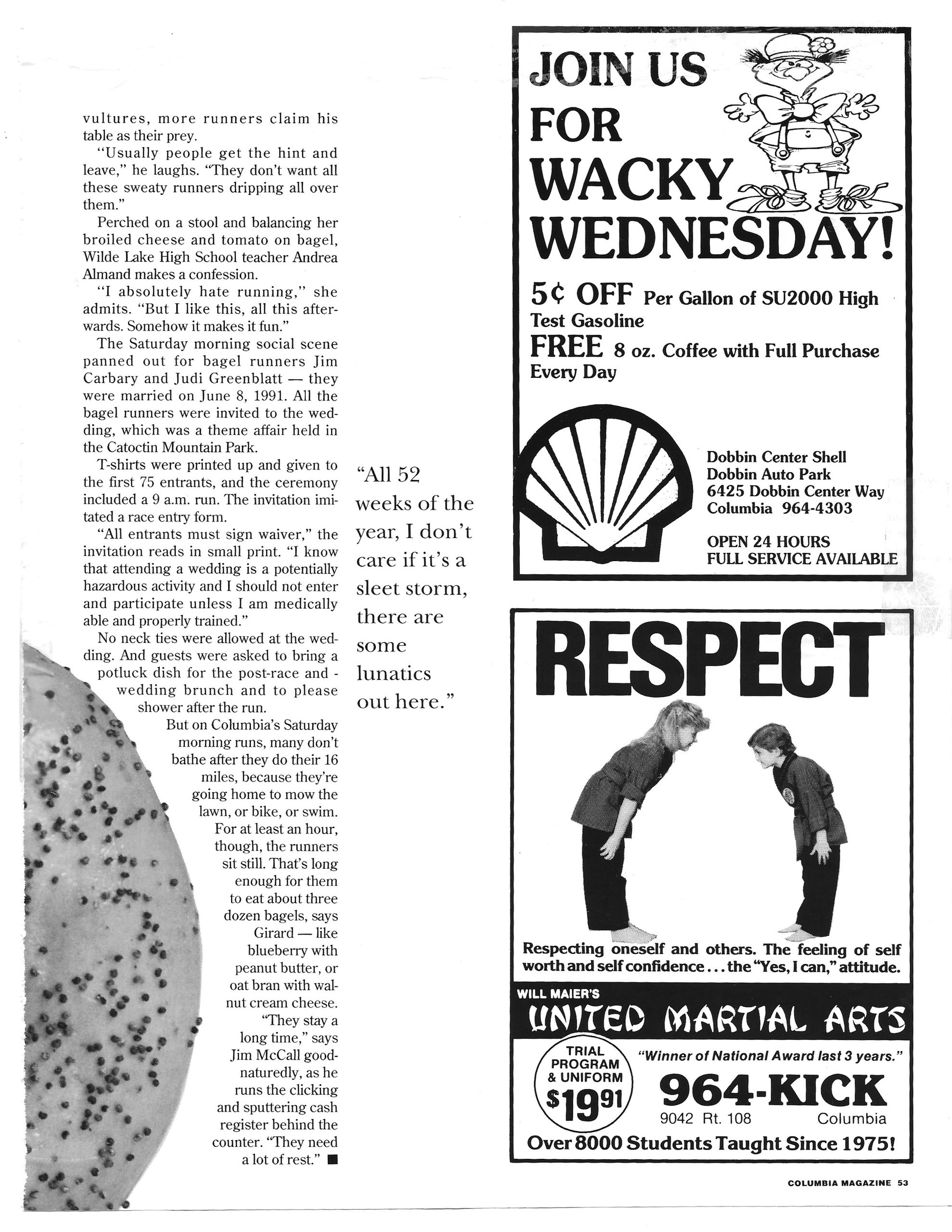
By the end of the decade, the Striders had joined the Road Runners Club of America, secured nonprofit status, and established key traditions that endure today. Feet First became the beating heart of the Striders’ weekly runs. The Saturday gatherings that began informally soon became known as the ‘Bagel Run’, named after the Bagel Bin in Wilde Lake Village Center, a ritual that connected generations of runners and continues an unbroken streak of runs that lasts to this day.
The 1980s: Growth, Competition, and Tradition
The 1980s marked a decisive turning point for the Howard County Striders. What had begun as a spirited local club matured into a powerful regional force with growing influence, membership, and tradition. Annual dues were modest—$4 for individuals and $8 for families—but the club’s ambitions were anything but small. This was the decade when the Striders proved themselves in competition, created enduring community traditions, and solidified their place in Maryland’s running history.
In 1980, the Junior Striders program was launched, giving young runners such as eight-year-olds Jason Tripp and Brian Shadrick a structured way to train and compete. The Columbia 13th Birthday Classic—a 13.1-mile race—was run that summer, and the club made its debut in the RRCA 10-Mile Club Challenge. For years, Baltimore and D.C. clubs had held the event in Columbia; that year, they agreed to let the Striders stage it in exchange for competing. They soon regretted the decision. Led by Don Uphouse (first male) and Alyssa Terry (first female), the Striders defeated the rival clubs.
That same year, on July 13th, the Striders launched their first Women’s Distance Festival, joining a national RRCA campaign to demonstrate that women could race far beyond the 800 meters then permitted at the Olympics. The WDF became one of the longest-running women’s races in the state. In December, Volume 1, Number 1 of the Howard County Striders Newsletter appeared, chronicling the club’s growing presence.
By 1981, the Striders had become a year-round institution. The first potluck annual meeting and awards dinner was held, a formal Racing Team was created, and two winter fixtures—the Turkey Trot and the Resolution Run—were launched.
The early 1980s were also years of dominance in the Club Challenge. By 1982, the Striders had captured their third straight title. Membership hit 669. Don Heinicke was inducted into the Maryland Sports Hall of Fame. Jim Clelland ran a blistering 14:19 5K at the Penn Relays. A Striders relay team covered 250 miles, 875 yards in the D.C. Road Runners 24-Hour Relay. Don Uphouse qualified for Boston with a 2:29 marathon.
The club’s national ambitions grew as well. In 1983, Kathy Heckman finished 20th at the Boston Marathon in 2:49:08, earning her Olympic Trials berth. That same year, Joe Wagner became the first Strider to complete the Hawaii Ironman. In 1984, Miles Weigold became club president. Heckman competed at the Trials, finishing 74th of 250 runners in 2:46:18. The Dave Tripp Youth Fund was established to support junior athletes reaching national competitions. Feet First began selling Strider logo gear, and the first Columbia Triathlon—directed by Weigold and won by Strider Reg Hahne—debuted.
Though the Striders lost the Club Challenge to Baltimore in 1985 after five consecutive wins, the year was a milestone for the club’s civic voice. When the State of Maryland proposed closing the pedestrian tunnels under Route 175, the Striders organized effectively to keep them open, preserving vital infrastructure for runners, pedestrians and bicyclists. The newsletter expanded to quarterly publication. Jeff and Karen Cohen purchased Feet First from original Strider Warren Ohlrich, and construction began on the loop trail around Centennial Lake.
In 1986, the Club Championship Series was launched, and the Striders hosted the Southern Police Institute Run for the Howard County Police Department. Phil Riehl became president in 1987 and led the club back to victory at the Club Challenge after a two-year drought. The All-Fruit Relay debuted the same year, adding a touch of whimsy to the club calendar, with four person teams competing on an 8 mile course while using a piece of fruit as their baton.
By the late 1980s, the club’s identity was firmly established. The Centennial Fun Run celebrated its tenth anniversary in 1988, and Abby Glassberg represented the club at the New Zealand Marathon in extreme heat. In 1989, Paul Goldenberg became president, and Jim Carbary began his extraordinary 24-year run as newsletter editor. That year, Carbary also ran 56:15 at the Annapolis 10 Mile Run. The club launched an educational partnership with Howard County Public Schools, established the John Scherer Scholarships, and participated in the first Maryland State Games Torch Run. The Masochist Marathon was held for the first time. The 24-Hour Relay moved from Fort Meade to Howard High School, where Striders team KHYLL-6 covered over 255 miles. Gerry Clapper ran 49:23 at Michigan’s Bobby Crim 10 Miler. By decade’s end, membership dues stood at $10 per individual and $15 per family—still modest for a club that had become a true institution.
The 1980s were not just years of competition but of infrastructure, identity, and tradition. Club Challenge dominance, the Women’s Distance Festival, Clyde’s 10K, Columbia Triathlon, Centennial Fun Run, and a maturing newsletter all reflected an organization that had grown from local roots into a defining force in Maryland running.
The 1990s: A Club in Full Stride
The 1990s were a decade of consolidation, expansion, and celebration for the Howard County Striders. The club entered the new era as a mature organization with a strong racing presence, a deep sense of community, and a growing emphasis on outreach and excellence. In 1990, the club’s newsletter was officially renamed FOOTPRINTS, a reflection of both its evolving identity and its commitment to documenting the club’s story. That same year, Ellen Coffey and Jason Tripp became the first recipients of the John Scherer Scholarship, which recognized promising young athletes and reinforced the club’s investment in the next generation of runners.
By 1992, the Striders launched one of their most influential programs: Females in Training (FIT), under the leadership of Pat Brooks and Barbara Calvert. FIT provided a welcoming structure for women entering the sport, offering training, community, and mentorship. The same year, the first change to Clyde’s course was made, and the Police Pace 5K debuted. More than just a race, the event was designed to raise funds for families of Howard County officers killed or injured in the line of duty and to support departmental needs beyond the regular budget. Both FIT and Police Pace would become enduring pillars of the club’s community engagement.
In 1993, Nadia Wasserman became club president as Columbia celebrated its 26th birthday. The Columbia Birthday Marathon marked the occasion with a full 26.2-mile race. That year, several Striders courses—including Clyde’s, WDF, Columbus Chase, and the Columbia Birthday Marathon—received USATF certification, ensuring accuracy and elevating the professionalism of club events.
The club’s commitment to excellence was recognized nationally in 1994, when Paul Goldenberg, Jim Carbary, and Warren Ohlrich received RRCA National Volunteer Awards for contributing over 2,000 hours of service. Bea Marie Fritsch won the Women’s Distance Festival in 17:44, the Junior Runner of the Year Award was established, and the Run Through the Grapevine 8K made its debut. Directions for a new Bagel course were published, and membership climbed to 883. Dave Tripp concluded his long tenure on the Board, closing one chapter of foundational leadership as the club continued to grow.
Membership passed 1,000 by 1995, reaching 1,035 members. Dave Berardi won the Shamrock 5K in 14:59. Bea Marie Fritsch captured the Westminster Mile in 4:39, with Vicki Lang close behind in third at 4:51. Ken Fowler won the Columbus Chase 10K in 31:04. Nelson Stritehoff, Tom Green, Tim Beaty, Mel Quecan, and Paul Goldenberg completed the JFK 50 Miler. That same year, the Striders entered the digital age with their first website—a reflection of both their size and their forward-thinking approach to communication.
The club continued to build on its traditions. In 1996, Dickie George was elected president. The third annual Bagel-to-Bagel-to-Bagel Run attracted 97 participants as runners traced a route from the Bagel Bin in the Enchanted Forest Shopping Center to Wilde Lake Village Center and Kings Contrivance Village Center. Chris Chattin ran a 50:24 PR at the Cherry Blossom 10 Miler, showing the competitive spirit still thriving within the club.
In 1997, the Striders swept both the men’s and women’s divisions at the 10 Mile Challenge, with the men going 1–2–3 overall. Membership reached an all-time high of 1,076. The A team also won the Cherry Blossom team competition, Tom Green completed the Old Dominion 100 Mile Run—his 100th ultra—and Chris Chattin ran 31:34 at Pike’s Peek 10K. Dave Berardi posted a 1:10:44 at the Philadelphia Distance Run. Piriya Pinit added to his medal count at the Maryland Senior Olympics with two golds, one silver, and one bronze.
In 1998, the Striders won the Club Challenge again. The Hall of Fame was inaugurated, with Gerry Clapper and Bea Marie Altieri as the first inductees. The FIT program attracted over 300 runners, and Olympic silver medalist Grete Waitz spoke at Howard Community College. The club also launched its first email list, signaling another step toward digital communication. That same year, the Striders lost a founding figure: Ken Denson passed away in Palestine, Texas.
By 1999, the Striders claimed their third consecutive Challenge victory, further asserting their dominance in the regional racing scene. John Bingham of Runner’s World joined the Penguin Pace, and the first Damien’s Run for Recovery 5K was held, adding another community-centered race to the calendar.
Throughout the 1990s, the Howard County Striders balanced racing excellence with community building, inaugurating new events while maintaining respect for established runs. Athletes like Berardi, Fritsch, Chattin, and Green shone on the roads and trails. Volunteerism, course certification, and digital communication positioned the club to enter the next millennium stronger than ever. The decade closed with the Striders at their competitive and organizational peak—a true force in Maryland running.
The 2000s: Innovation and Endurance
The new millennium saw the Striders continue their innovation in programs and races and further establish close ties to the local community. Entering the 2000s, the club was already one of Maryland’s most established running organizations, but they continued to move forward. New races and programs emerged, signature events thrived, and the club continued to honor the figures who had built its foundation.
The year 2000 began with recognition for the old guard and success for the current generation. Dave Tripp, one of the early architects of the club’s structure and growth, was inducted into the Strider Hall of Fame. The Men’s A Team captured the Cherry Blossom 10 Miler team title for the second straight year, underscoring the club’s competitive strength on a major regional stage. Meanwhile, the Columbus Chase 10K was canceled due to a lack of sponsorship and race leadership—a rare pause in an otherwise growing race calendar—and the Metric Marathon shifted from late November to early October, a move that positioned the race more favorably in the fall racing season.
In 2001, new leadership arrived with Mick Slonaker’s presidency, bringing both innovation and celebration of the club’s past. Hall of Fame inductions that year honored Don Heinicke, Arleen Dinneen, and Judy Tripp—each a central figure in shaping the Striders. Clyde’s 10K debuted a new course, including the now infamous Route 108 hill, a feature that became a defining test for runners for years to come. Chris Chattin won the Annapolis 10 Miler, and the Junior Striders summer program was launched, laying the groundwork for future generations of young runners.
The year 2002 showcased the Striders’ ability to blend humor and community spirit with competition. The first Bagel-to-Beer Marathon, a light-hearted but challenging event, joined the calendar. Tim Beaty and Miles Weigold were inducted into the Hall of Fame, while Edmund Burke ran a blistering 49:47 at the Cherry Blossom 10 Miler. Gerry Clapper was honored by the Maine Running Hall of Fame, and Clyde’s introduced chip timing—another step forward in the modernization of the club’s major events.
The winter of 2003 brought an unexpected interruption: the 10 Mile Challenge was canceled due to snow, a rare occurrence for a race so central to the club’s identity. But the rest of the year more than compensated. Clyde’s 10K drew a record 1,153 finishers. Arleen Dinneen’s Centennial Fun Run marked its 25th anniversary, Carrie Selmer and Tom Williams set a co-ed record at the 5 Mile Relay in 24:24, and the Women’s Distance Festival moved its starting time from midnight to a more traditional morning start. Phil and Vicki Lang swept Runner of the Year honors, and Bea Marie Altieri captured victory at the Walt Disney World Marathon.
The following year brought further growth and leadership transitions. In 2004, Phil Lang was elected president, the Next Step program was launched to guide newer runners, and the Striders won the 10 Mile Challenge on its debut of a new course. Nadia Wasserman and Dave Berardi were inducted into the Hall of Fame, and Edmund Burke raced in the U.S. Olympic Marathon Trials, setting a personal best of 2:21:47—cementing himself among the club’s elite.
The middle of the decade was marked by recognition of contributions that stretched far beyond the roads. In 2005, Arleen Dinneen was inducted into the Howard County Sports Hall of Fame. That same year, Leonard Guralnick was elected president. In 2007, the club launched the Run for Remembrance Rotary 5K to benefit the Dave Tripp Scholarship Fund, reflecting the club’s longstanding commitment to community causes.
The latter part of the decade brought more leadership transitions and moments of reflection. Maggie Moraw was elected president in 2008, and Nadia Wasserman returned to the presidency in 2009. That year, Phil Lang was inducted into the Howard County Sports Hall of Fame. But 2009 also brought a somber milestone: the passing of Striders founder and inspirational figure Don Heinicke at age 93. His legacy was visible everywhere—from the Bagel Runs and community races to the elite racing team that continued to shine in local events.
Throughout the 2000s, the Striders balanced forward-thinking innovation with deep respect for their roots. Hall of Fame inductions honored the past; youth programs and digital tools prepared the future. Signature races like Clyde’s, the Women’s Distance Festival, and the 10 Mile Challenge thrived, while new events like The Bagel to Beer Marathon and Run for Remembrance 5K deepened the club’s character. It was a decade of evolution built on endurance—a reflection of the very sport the Striders champion.
The 2010s: A Living Legacy
The 2010s marked a new chapter for the Howard County Striders—an era in which technology and tradition ran stride for stride. Entering its fifth decade, the club embraced digital tools and social media without losing sight of its founding spirit of camaraderie, excellence, and a deep love of running.
The decade began with a renewed focus on the next generation. In 2010, Bullseye Running was formed as the official coaching entity for the Junior Striders, providing structured training and mentorship that ensured the club’s legacy of youth development would continue. The program blended competitive skill-building with community values, producing both accomplished young athletes and lifelong runners.
In 2011, Dwight Mikulis was elected president, guiding the club into a digital renaissance, securing the clubs financial foundation, and expanding programs to include runners of all abilities. FOOTPRINTS, the club’s beloved newsletter, transitioned from print to a digital format, vastly expanding its reach while preserving its storytelling tradition. Paul Goldenberg, one of the club’s stalwarts, was inducted into the Howard County Sports Hall of Fame, honoring decades of leadership and service.
The Striders expanded their online presence in 2012 with the launch of their official Facebook page, opening new channels of communication and connection for runners across the region. That same year, Bobby Gessler, Carlos Renjifo, and Corey Hamilton received Goodsports Awards at the 10th Annual Howard County Celebration of Sports. These honors reflected both athletic achievement and the club’s ongoing commitment to promoting sportsmanship and community engagement.
In 2013, Bill Arbelaez assumed the presidency, and Miles Weigold was inducted into the Howard County Sports Hall of Fame. That same year marked the end of an era when Jim Carbary—FOOTPRINTS editor since 1989—retired and moved to Southern California. His final column, “Better Nate than Lever,” closed 24 years of storytelling that had chronicled the heart and humor of the Striders community.
Under Donnie Chapman’s presidency in 2015, the club continued to evolve while preserving its traditions. In 2016, the Striders launched a redesigned website—modern, accessible, and reflective of their storied past and forward-looking mission. The relaunch of FOOTPRINTS ensured the stories of races, runners, and milestones would continue to inspire both longtime members and new recruits.
That same year, Julia Roman-Duval qualified for the U.S. Olympic Marathon Trials with a 2:40:55 at the California International Marathon. In 2018 she won the Baltimore Marathon and later lowered her PR to 2:36:31. She joins Don Heinicke, Don Uphouse, Kathy Heckman, Pat Wilkerson, Chris Chattin, Edmund Burke, Hannah Betman, and Caroline Bauer as Striders who have reached Olympic-level qualifying standards.
While Clyde’s 10K, the Women’s Distance Festival, the Metric Marathon, and the 10 Mile Challenge remained anchor events on the regional racing calendar, the club expanded its digital presence, elevated its youth programs to national prominence, and saw its competitive teams challenge Olympic standards. Clyde’s 10K remained one of Maryland’s premier road races, drawing more than 1,700 finishers in 2013, including standout performances from Kyle Stanton (31:27) and Katie Ogden (38:15). The Metric Marathon and the 10 Mile Challenge flourished, supported by large volunteer contingents and competitive fields that reinforced the Striders’ reputation as expert race organizers.
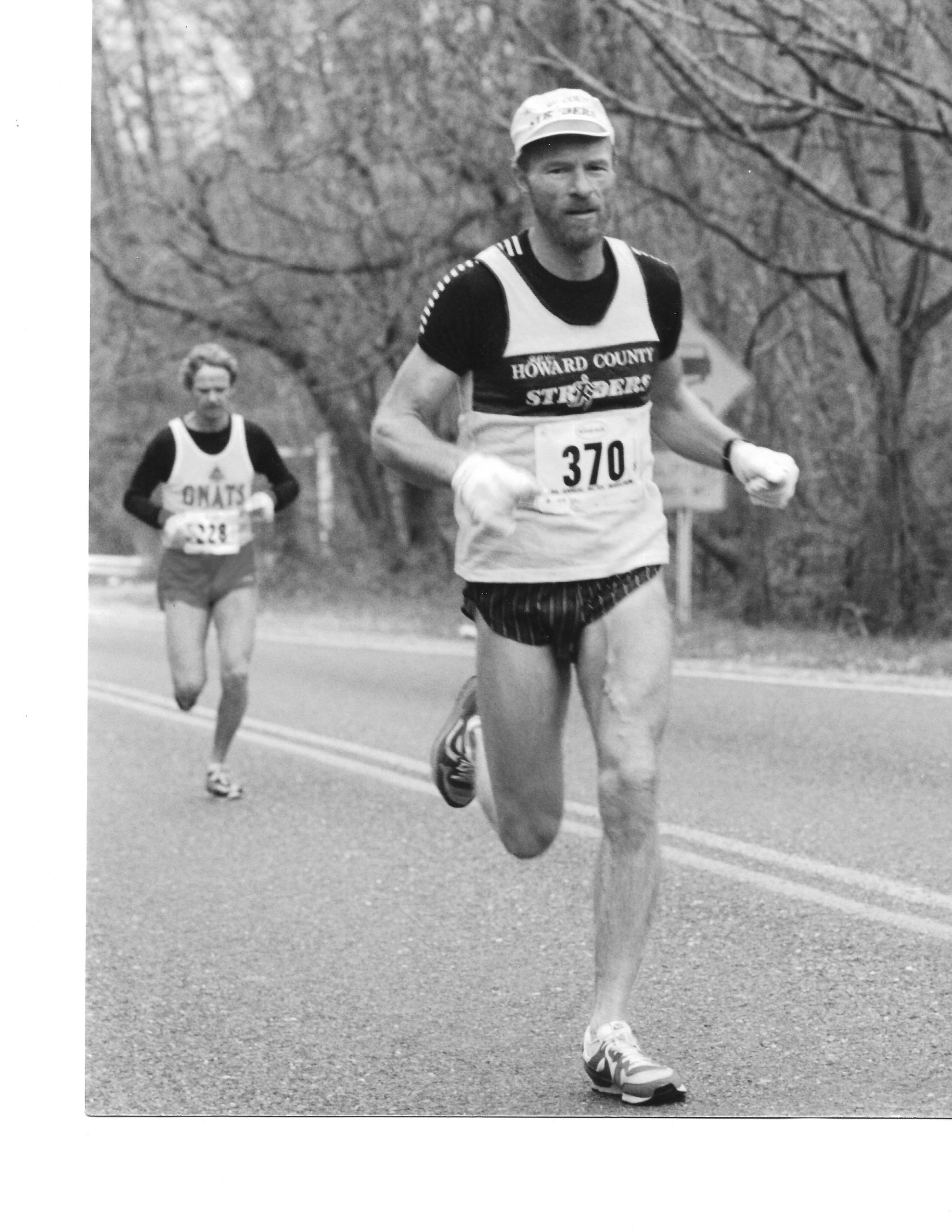
The decade also saw remarkable individual performances. Caroline Bauer emerged as a standout competitor, setting the Striders Racing Team’s 50-mile record at the Stone Mill 50 Miler and posting top finishes at the Cherry Blossom 10 Miler, Clyde’s 10K, Annapolis 10 Miler, and Shamrock Half Marathon. She ran 2:47 in the marathon twice, putting herself on the brink of Olympic Trials qualification, which she later achieved at the 2019 Chicago Marathon with a 2:44:07. Julia Roman-Duval’s 2:42:59 marathon at the 2016 Chicago placed her among the nation’s top women, underscoring the club’s depth at the elite level. Other team members excelled at Pike’s Peek 10K, the Annapolis 10 Miler, and other major regional races.
Youth development was a defining strength of the decade. The Junior Striders program, guided by Bullseye Running, produced state champions and national-caliber competitors. In 2017, members of the girls’ 11–12 4×800 relay team and several individuals medaled at the AAU Junior Olympic Track & Field National Meet. That fall, the team traveled to Charlotte, North Carolina, to compete at the AAU Junior Olympic Cross Country Nationals. These achievements reflected years of coaching dedication and volunteer leadership and cemented the Junior Striders as a national presence.
Community engagement remained central to the Striders’ identity. Programs like FIT and Next Step drew in newcomers, especially women and runners rediscovering the sport. The Bagel Run, with an unbroken run of participation, celebrated its 2,000th run in 2017 (see below for article), a milestone of consistency and community spirit. The club maintained close partnerships with Howard County institutions, ensuring smooth logistics for races and events. Volunteerism was celebrated in FOOTPRINTS as a cultural cornerstone. Hall of Famer Dennis Albright exemplified this spirit, stepping in to direct Clyde’s 10K, supporting high school cross-country programs, and embodying the ethos of giving back.
The decade also brought moments of reflection and remembrance. In 2019, tributes poured in for Mike Fleming—a Hall of Famer who had served as club photographer, coach, and mentor for more than a decade. His passing was felt deeply across the Striders community and underscored how individual contributions shape a collective legacy.
By 2019, the club entered another period of renewal. FOOTPRINTS editor Allan Field passed the baton to Michelle Pelszynski, whose own running journey began through Girls on the Run and the Saturday Bagel Runs. Her leadership symbolized a generational handoff, ensuring the club’s traditions would continue into the next decade.
Throughout the 2010s, the Howard County Striders maintained their dual identity: a fiercely competitive racing organization and a deeply rooted community of runners. Their events continued to draw hundreds each year, their programs developed athletes from youth to masters, and their volunteers sustained the club’s spirit of community. By the close of the decade, the Striders were more than a running club—they were an institution bridging generations of runners and showcase deep community involvement.
The 2020s: COVID and Beyond
The early months of 2020 carried the familiar energy of racing, training, and tradition. The club entered the new decade strong—anchored by its hallmark events and powered by its training groups, youth programs, and dedicated volunteers. But within months, everything changed.
As the COVID-19 pandemic arrived in March, racing and group training ground to a halt. Spring events were canceled or postponed, and the club quickly pivoted to virtual formats and creative solutions. Runners embraced solo and distanced running on roads, trails, and neighborhood loops, sustaining community connection in new ways.
By fall 2020, Striders embodied the words “strong, creative, and unstoppable.” Members turned canceled races into backyard events, organized small group runs, and motivated family and friends to train for their first 5Ks and 10Ks. Many embraced cross-training—paddle boarding, hiking, cycling—and found new ways to stay engaged with the sport
In late 2020, the Striders reintroduced small, in-person racing under strict safety protocols. Run Through the Grapevine returned in November with capped registration, wave starts, no indoor gatherings, and mask requirements. The Turkey Trot Prediction Run moved to a new location—Burleigh Manor Middle School—to allow for more spacing and safety, while preserving the tradition of starting at any time and finishing closest to 11:00 a.m.
The Junior Striders and Bullseye Running programs adapted rapidly. When national meets and school events were disrupted, the club and its coaching staff worked to keep young athletes engaged with virtual challenges and small, distanced practices. Events like the Back to School Virtual Challenge in September encouraged athletes to log miles creatively—touching local schools, mapping new routes, and maintaining the team’s spirit from a distance
The trails around Howard County—especially in Patapsco Valley State Park—became a refuge for many. Trail runners adjusted to etiquette shaped by the pandemic: distancing, yielding space, carrying masks or buffs. Events like the Patapsco Trail Fest 2020 went virtual, keeping the spirit of competition alive without the crowds.
As COVID restrictions continued for several more years, small groups of Striders organized events for their ‘bubble’. These include groups running every street in Columbia, over 1,300 roads and 450 miles, and runners finishing David Goggins 4x4x48 (four miles every four hours for 48 hours)!
Through these adjustments, the Striders maintained their identity as a running community rooted in camaraderie. The club’s resilience during COVID mirrored its long history: adapting to change while preserving what mattered most.
From the early handwritten newsletters of the 1970s to the digital records of recent years, one thing has stayed consistent: the Howard County Striders are a community that keeps moving—connected by shared effort, steady commitment, and a common love of running.
Striders List of Presidents
Presidents from 1976-Present
- 2025- Hafiz Shaikh
- 2022-2025 Bill Brown
- 2019-2021 Cecilia Murach
- 2017-2018 John Bratiotis
- 2015-2016 Donnie Chapman
- 2013-2014 Bill Arbelaez
- 2011-2012 Dwight Mikulis
- 2009-2010 Nadia Wasserman
- 2008- 2009 Maggie Moraw
- 2006-2007 Len Guralnick
- 2004-2005 Phil Lang
- 2001-2003 Mick Slonaker
- 1996-2000 Dickie George
- 1993-1995 Nadia Wasserman
- 1989-1992 Paul Goldenberg
- 1988- 1989 Phil Riehl
- 1984-1987 Miles Weigold
- 1979-1983 Dave Tripp
- 1976-1978 Don Heinicke